

Custom Software vs Off-the-Shelf Software: Which Is Right for Your Business?
In short
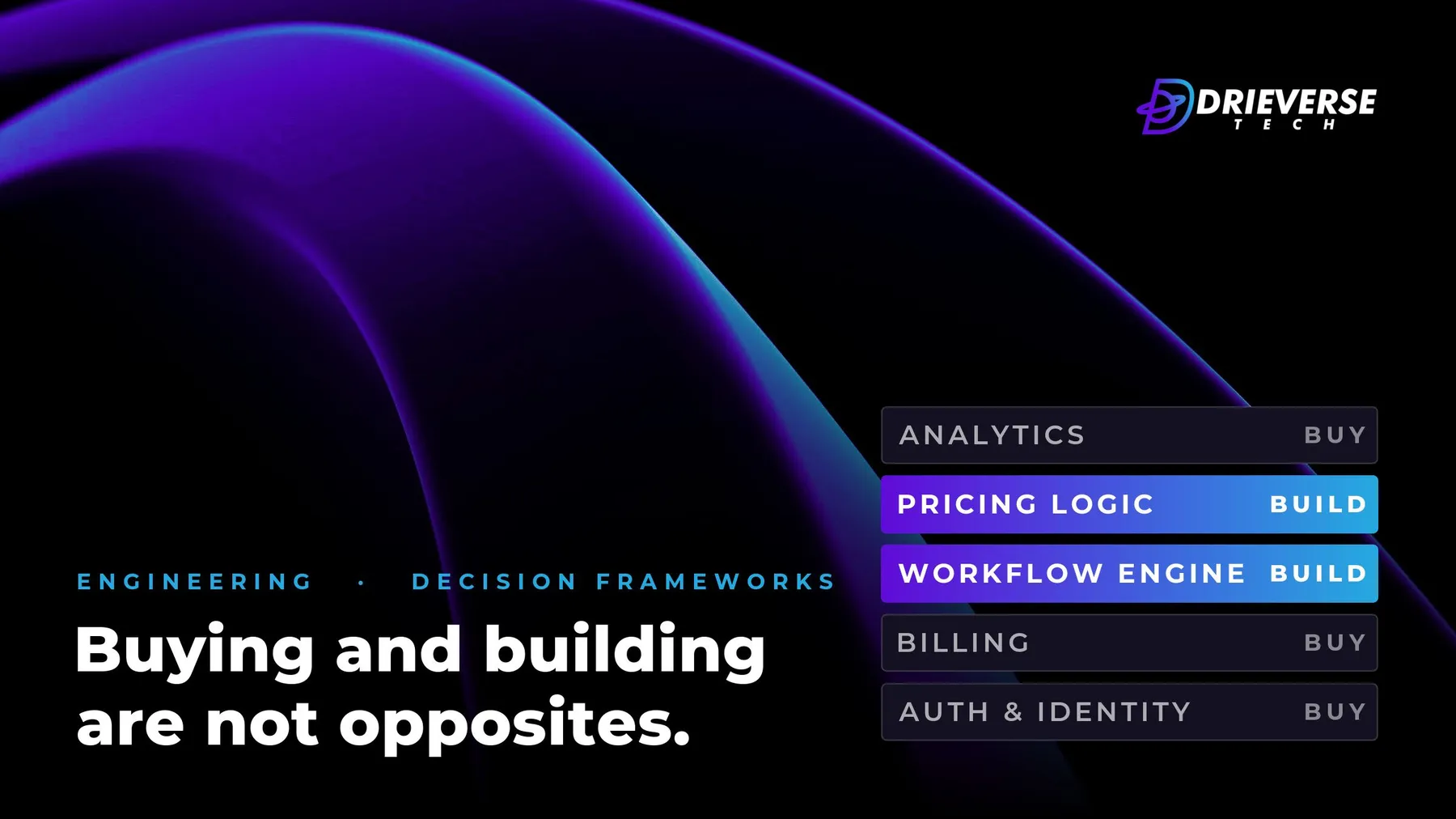
Buy off-the-shelf software when an existing product fits your actual workflow with acceptable integrations and ownership terms. Build custom software when your workflow, integrations, or differentiated capabilities keep failing that same test. Most mature businesses need both: buy the commodity layer, build the layer that makes you different, and connect the two deliberately.
Key takeaways
- Buy versus build is not a technology decision. It is a question about whether an existing product fits your actual workflow, not how many features it has.
- The sticker price is the smallest number in the comparison. Implementation, integration, training, and the ongoing cost of whichever workaround you are running today all belong in the same decision.
- A hybrid approach is usually the right one: buy the commodity layer everyone needs, build the layer that makes your business different, and connect the two on purpose.
- Custom software is not automatically more secure, faster, or cheaper. Those outcomes come from how the system is designed and operated, not from the fact that you built it.
- The workaround your team is already running, the spreadsheet, the manual reconciliation, the copy-paste between two systems, is a real cost. Most comparisons leave it out entirely.
Table of contents
The question is fit, not features
Every build-versus-buy comparison eventually turns into a features table, and that is usually where it goes wrong. A product with more checkboxes than a competitor is not automatically the right answer, and a custom build is not automatically the sophisticated one. The only question worth answering first is whether the option fits the way your business actually works, with the least complexity you can get away with.
Sometimes that means buying an existing product and configuring it. Sometimes it means building something that does not exist yet. Often it means both, and the businesses that get this decision wrong are usually the ones that treated it as a technology question from the start, instead of a business one.
What "off-the-shelf" actually costs
The appeal of an existing product is real: it already exists, it already has a feature set, and it can very often get a team moving faster than a from-scratch build. None of that is wrong. But "ready-made" is not the same as "zero implementation," and the parts that get glossed over in a sales conversation are the parts that show up in the first quarter of ownership: configuration, data migration, integrations that turn out to be shallower than the demo suggested, permissions, training, and a subscription line that renews whether or not the tool still fits.
The question that actually predicts whether an off-the-shelf product will work is narrower than "does it have enough features." It is whether it fits the workflow you already run, including the parts of that workflow that make your business different from the next one on the vendor's customer list.
What "custom" actually costs
Custom software inverts the trade. You get control over workflow, business rules, integrations, and system behavior that a packaged product was never going to bend far enough to match. That control is the entire reason to build, and it is worth real money when a standard product keeps failing the fit test in a way that costs the business more than the build would.
It is also not free in the way "we'll just build it" conversations sometimes imply. A custom system carries its own weight: requirements, architecture, development, testing, deployment, documentation, monitoring, and the ongoing maintenance and security work that does not stop once the first version ships. None of that makes custom software the wrong choice. It makes it the choice you make because the requirements justify it, not because building feels more serious than buying.
The trade-off in one table
| Factor | Off-the-shelf | Custom |
|---|---|---|
| Initial deployment | Often faster | Requires design and development |
| Process fit | Shaped by the product's own workflow | Designed around your requirements |
| Integrations | Limited to what the vendor already built | Can be built to spec |
| Vendor dependency | Usually higher | Usually lower, depending on architecture |
| Product roadmap | The vendor's call | Your call |
| Differentiated workflows | Limited by the product's ceiling | As flexible as you design it to be |
| Main risk | Product and vendor fit | Build, maintenance, and long-term ownership |
None of these rows are a verdict. A fast off-the-shelf deployment can still be the wrong one if the fit is wrong, and a slower custom build can still be the right one if the requirement is real. The table is a starting checklist, not the decision itself.
Buy the commodity, build what makes you different
The decision does not have to be all or nothing, and for most businesses past the earliest stage, it shouldn't be. The useful framing is closer to this: buy the commodity layer, build the differentiated layer, and connect the two on purpose.
Robert Sher, who advises midsize companies on exactly this question, makes the same distinction from the growth side: homegrown software earns its cost when it becomes the thing that actually drives innovation or a real efficiency advantage in how the business operates, not when it is standing in for a solved problem. An off-the-shelf answer to the thing that is supposed to make you different cannot actually be a differentiator, because a competitor can buy the exact same product. Anything that is not core to that difference is, by definition, a candidate to buy rather than build.
In practice, that looks like a CRM for standard customer management plus a custom workflow layered on top of it. An accounting platform plus custom reporting that actually matches how the business tracks the numbers that matter to it. An e-commerce platform plus the business logic that makes checkout, fulfillment, or pricing behave the way this specific business needs it to. Nobody has to rebuild what the market has already solved well, and nobody has to accept a ceiling on the part of the business that is supposed to be different from the competition.
The cost nobody puts in the comparison
Most build-versus-buy conversations stop at the sticker price on one side and a development estimate on the other, and both of those numbers are incomplete on their own. The off-the-shelf side needs implementation, migration, integration, training, administration, and support added to the subscription line. The custom side needs testing, deployment, monitoring, security, and the maintenance that continues for as long as the system is in production, added to the build estimate.
There is a third number that rarely makes it into the comparison at all: what the current workaround is already costing you. If someone on your team is re-entering the same data into two systems every week, reconciling numbers by hand because nothing talks to anything else, or maintaining a spreadsheet that exists because the product you bought does not do the one thing you actually need it to do, that time is a real, recurring cost. It belongs in the decision, not outside it, and it is very often the number that tips a close call in one direction or the other.
A shorter test than an eight-point checklist
Most build-versus-buy frameworks turn into long checklists, and long checklists are easy to fill out without actually deciding anything. The version that holds up in practice is shorter: name the specific workflow that has to work, check whether an existing product genuinely fits it (not whether it has enough features), price the real cost of ownership on both sides including the workaround you are already running, and ask what has to stay under your own control. If nothing about the workflow is genuinely different from what a good off-the-shelf product already handles, buy it and move on. If a specific, nameable part of it is different enough that no product fits and the workaround is expensive, that is a real case to build. Most of the time, the honest answer is both: buy what is already solved, build what is not, and connect the two.
Sources
- Robert Sher (Harvard Business Review): When Should Your Company Develop Its Own Software?: Robert Sher's argument that homegrown software earns its cost specifically when it drives real innovation or an operating advantage, not when it substitutes for a problem the market has already solved, is a direct, current statement of the differentiation argument made in this post.
Frequently asked questions
Not automatically. The right choice depends on how well an existing product fits your actual workflow, what the integrations require, who owns the ongoing maintenance, and what your current workaround is already costing you. Custom software is the right call when those factors justify building, not by default.
It can reduce upfront development cost, but the subscription price is rarely the full number. Implementation, data migration, integration work, training, administration, and support all add to it, the same way a custom build's cost extends well past the initial development estimate.
Build when a specific workflow, integration requirement, or differentiated capability keeps failing to fit standard products, especially once the workaround for that gap is already expensive to run. Building should be a response to a named, concrete requirement, not a default preference or a sense that custom is the more serious option.
Buy when an existing product solves the actual problem with acceptable workflow fit, integrations, and ownership terms. If nothing about your workflow is genuinely different from what a mature product already handles well, building it yourself adds cost without adding an advantage.
Yes, and for most businesses past the earliest stage, that is the realistic answer. Standard products can cover common functions like accounting or CRM, while custom software or integrations handle the specific workflows that are different enough to need their own build.
Compare workflow fit, integration depth, total cost of ownership on both sides, who needs to maintain it, how much vendor dependency you are accepting, and the cost of the workaround you are running today. The purchase price or the development estimate alone is not the comparison.
Have a Custom software development project like this in mind?
Tell us what you are trying to build. We will tell you plainly what Custom software development work like this would take.
Get a quoteContact Us
Lahore, Pakistan · London, U.K · Austin TX, U.S · Toronto, Canada